
What Regions Should You Invest In

Regions To Invest In
An important strategy for building a diverse portfolio is to include stocks from different geographic locations, both domestic and international. Many investors are reluctant to invest in international markets because domestic markets are seen as “safer”. This fear of the unknown results in ‘home bias’ whereby investors are overexposed to their domestic market.
While it can be scary to invest your money in companies and regions that are entirely unfamiliar to you, research shows that adding international stocks can help reduce volatility in your portfolio, protecting against risks specific to any particular region. Your returns may also benefit from the exposure to faster-growing segments of the global economy or regions that are trading at a discount relative to the stretched valuations of your domestic market.
When you invest internationally, you have the opportunity to invest in both developed markets and emerging markets.
Developed Markets
Developed markets have more advanced economies, stable financial markets, higher household income, better infrastructure and higher standards of living. Most developed markets are located in North America, Western Europe and Australia.
Developed markets such as the U.S. have performed strongly in recent years, but this may not always be the case as increasing reliance on debt, bloated valuations, and an ageing demographic weigh on the region’s future outlook.
Emerging Markets
Emerging markets refer to high growth regions driven by younger populations, higher consumption levels and integration with the global economy. They have lower household incomes, less developed capital markets as well as higher levels of political and economic instability. There can also be a considerable disparity in emerging market performance, with each region posing its own distinct risks and opportunities.
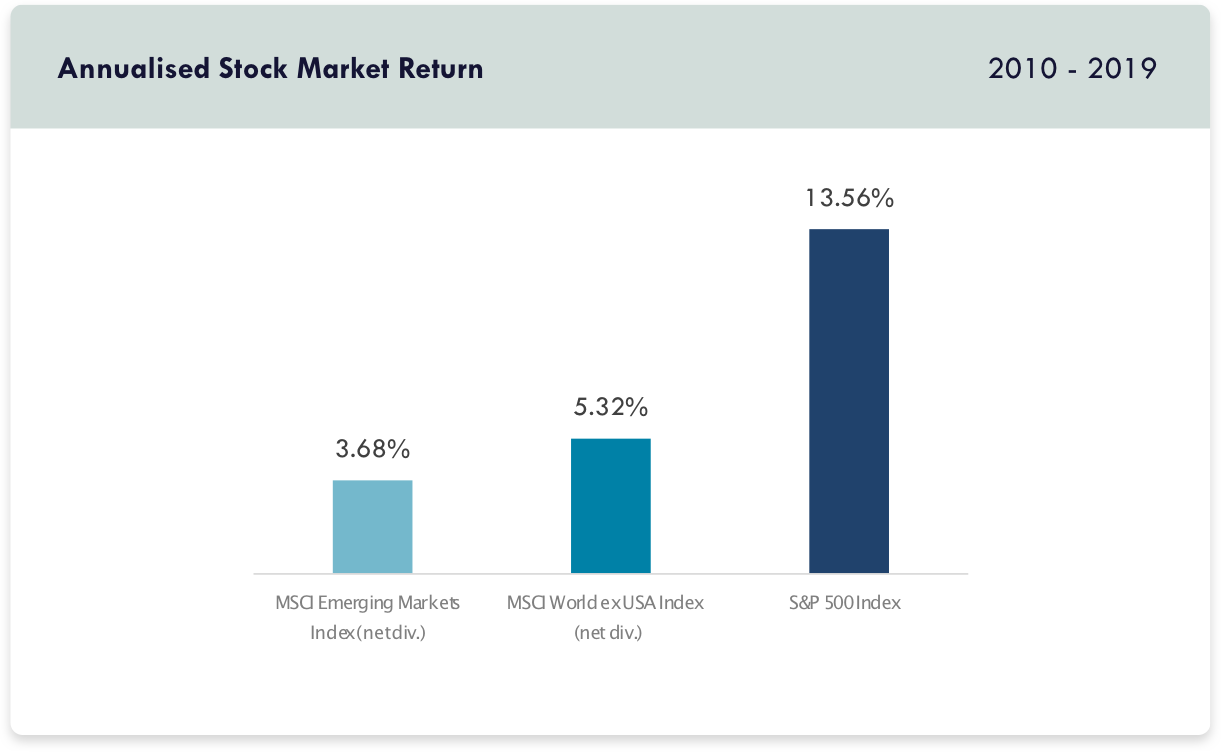
Despite the extra risks involved and the rapid growth potential on offer as growing populations fuel future consumption, U.S. markets in particular, have significantly outperformed emerging market indices over the last decade.
So, Which Is Better?
Trying to quantify the point at which this multi-faceted positive growth narrative translates into superior corporate earnings in these regions can be a humbling endeavour, but broad diversification over time offers access to these high growth markets without being overly exposed to declines in any one region.